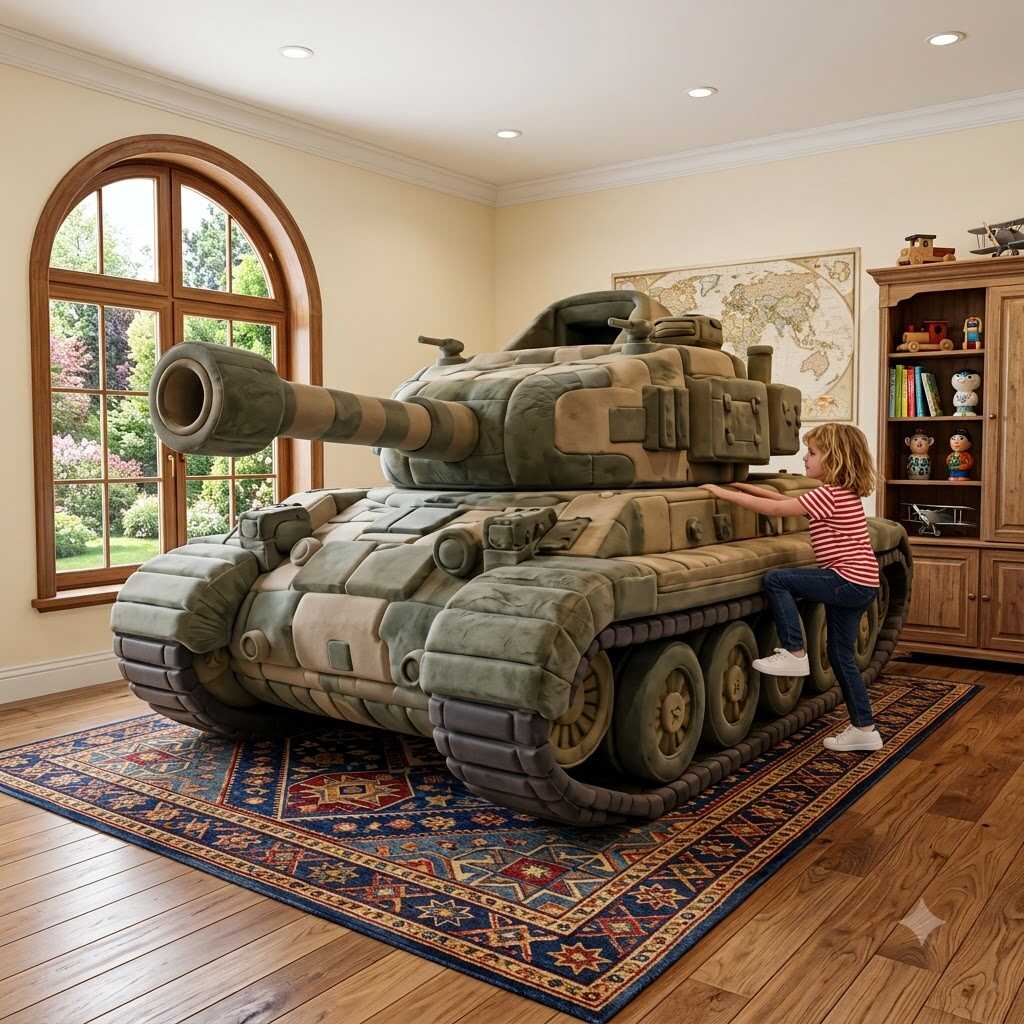
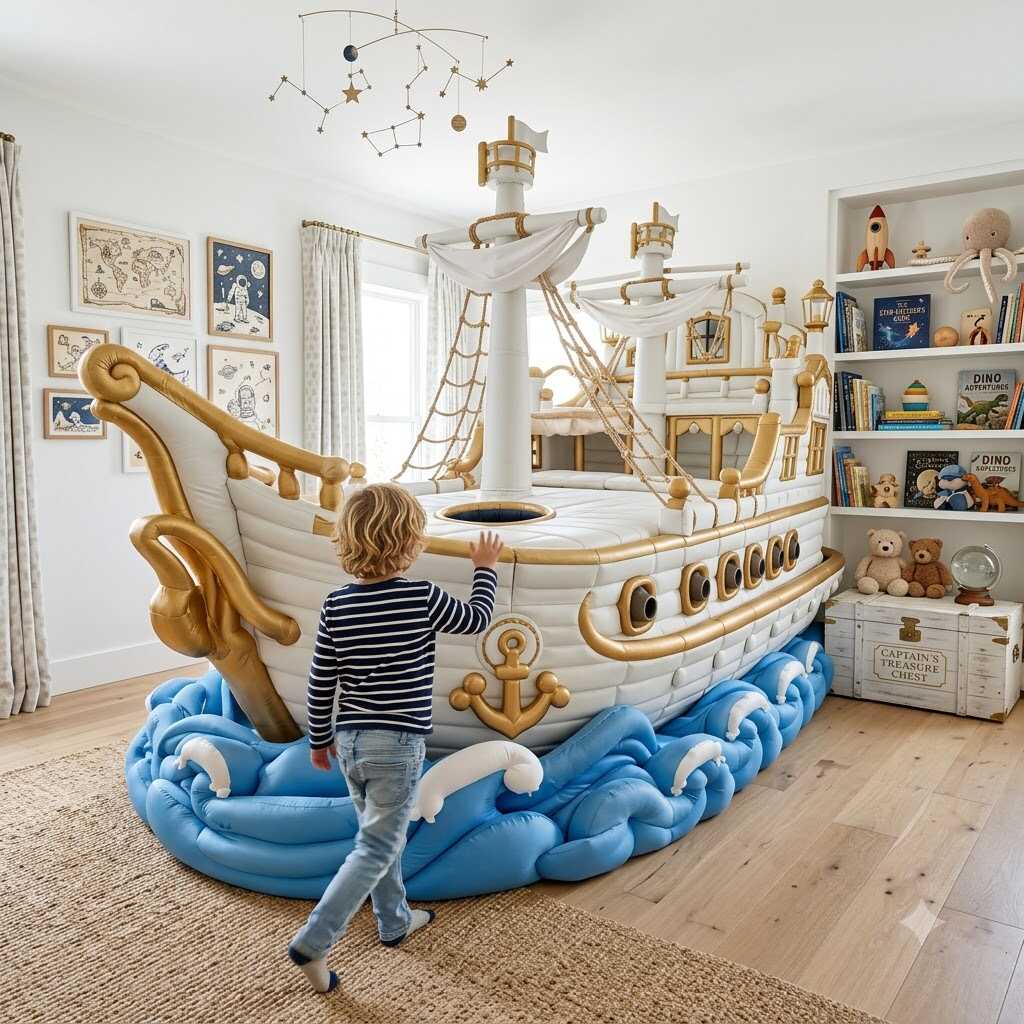
Walk into almost any children’s furniture showroom or scroll through a design studio’s portfolio, and sooner or later you’ll spot it: a hull-shaped headboard, a crow’s nest peeking over a mattress, a plank-textured frame that looks like it sailed straight out of a storybook. The GIANT FOAM PIRATE SHIP BED has become one of the most requested novelty furniture pieces in the themed bedroom world, and yet very few people understand what actually happens between “wouldn’t it be cool if…” and the finished piece sitting in a bedroom. The process is part sculpture, part engineering, and part theater set design, and it’s a lot more involved than most people assume.
Where the Idea Actually Starts
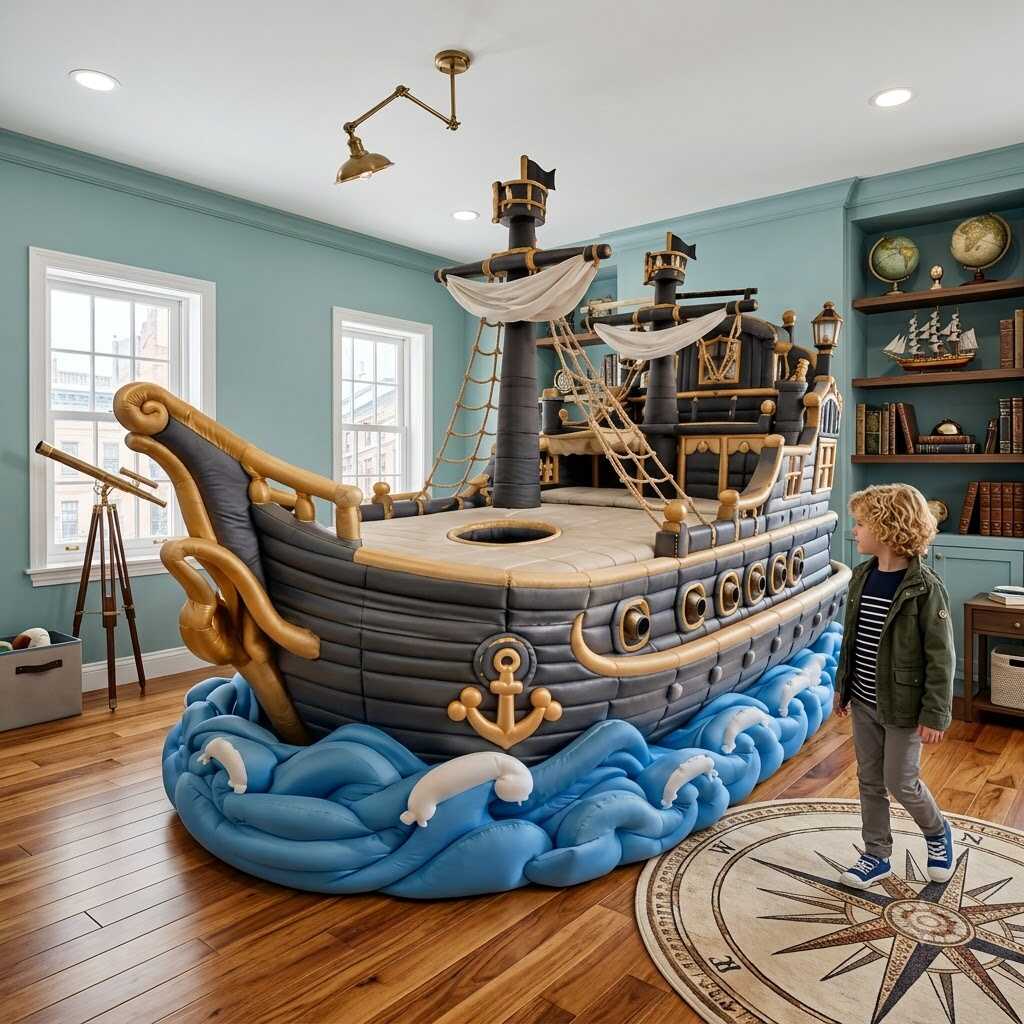
Every themed furniture project begins the same way: with a mood board. Designers don’t just Google “pirate ship” and start cutting foam. They pull references from old maritime illustrations, animated films, theme park attractions, and even real shipbuilding diagrams. The goal at this stage isn’t realism — it’s silhouette. A child (or an adult with a playful streak) needs to recognize “pirate ship” in under two seconds, so the designer is hunting for the two or three visual cues that instantly read as nautical: a curved bow, a raised stern, weathered plank lines, maybe a small mast or rope detail.
Once those cues are chosen, the sketching phase begins. Most studios still start with hand-drawn thumbnails before moving into 3D software like SketchUp, Rhino, or Blender. The 3D model matters enormously here because a FOAM BED isn’t just decorative — it has to function as an actual bed. That means the designer is simultaneously solving for aesthetics and for mattress dimensions, safety rail height, entry and exit points, and how the piece will fit through a standard doorway. It’s common for early concepts to look fantastic on screen and then get scaled back once someone measures a hallway.
Choosing and Understanding the Foam
Not all foam is created equal, and this is where a lot of hobbyist attempts fall apart. Commercial designers typically work with high-density polyurethane foam, sometimes paired with an EPS (expanded polystyrene) core for larger structural sections like the bow or the raised stern wall. The reasoning is simple: EPS is light and easy to shape in bulk, but it’s brittle and crumbles under repeated impact. Polyurethane is heavier and pricier, but it compresses and rebounds instead of cracking, which matters a great deal when the “furniture” in question is going to be climbed on, kicked, and used as a trampoline substitute by an eight-year-old at 6 a.m.
Density is measured in pounds per cubic foot, and most designers working on load-bearing sections aim for something in the 2.2 to 3.0 range — firm enough to hold shape, soft enough to stay safe. Decorative, non-structural elements like railings or small trim pieces can use lower-density foam since they’re not supporting weight.
Carving the Hull: The Sculpting Process
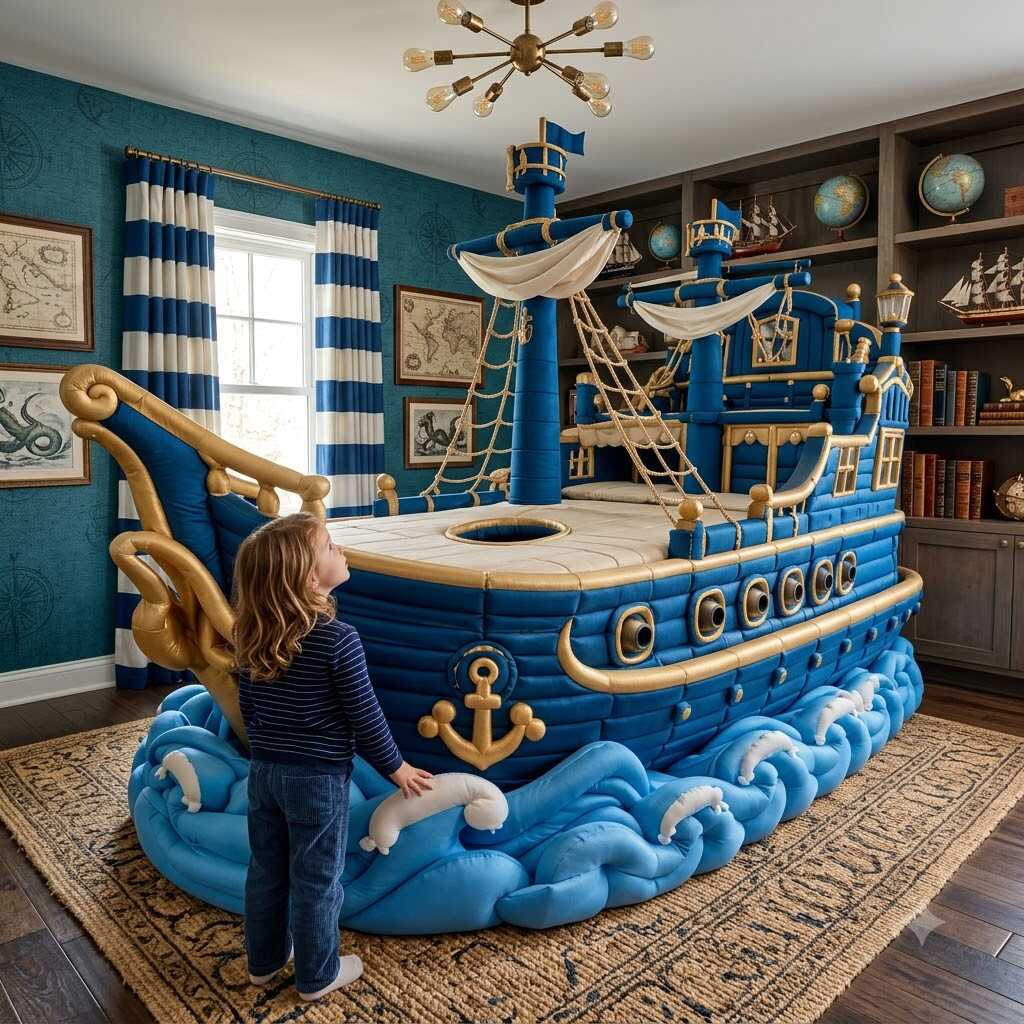
This is the stage most people picture when they imagine a GIANT FOAM PIRATE SHIP BED coming to life, and it’s genuinely closer to sculpture than furniture-making. Large foam blocks are first roughed out using a hot wire cutter, which slices through polyurethane and EPS cleanly without the crumbly mess a saw would leave behind. For the compound curves of a ship’s hull — the parts that flare outward and taper toward the bow — designers often switch to angle grinders fitted with foam-specific cutting discs, followed by rasps and sanding blocks for the final shaping.
Some studios now use CNC hot-wire cutting for the bulk shapes, especially when they’re producing more than one unit. A computer-guided wire follows a digital profile pulled straight from the 3D model, which keeps the hull curve consistent from one bed to the next. Even then, someone still goes over the piece by hand afterward, because CNC cutting handles broad curves beautifully but can’t replicate the slightly irregular, weathered look that makes a pirate ship feel handcrafted rather than injection-molded.
Plank lines are one of the small details that make or break the illusion. Designers score shallow grooves into the foam surface using a heated blade or a rotary tool, spacing them unevenly on purpose — perfectly straight, perfectly even planks read as fake immediately, while slightly irregular spacing tricks the eye into believing it’s looking at real timber.
Reinforcement: Where the Real Engineering Happens
Foam alone cannot support a mattress, a box spring, and an active child indefinitely, so every legitimate build includes an internal skeleton. Most designers use a lightweight plywood or MDF base frame, sometimes with a welded steel sub-frame for larger builds, and the foam shell is fitted over this structure rather than bearing weight itself. Bolts, threaded inserts, and industrial adhesive are used to lock the foam skin to the frame at key stress points — particularly around the headboard “bow” and any raised railings, since those are the areas children tend to climb on.
Weight distribution gets modeled early, often with the same 3D software used for the visual design, so the designer knows exactly where the frame needs extra bracing before a single piece of foam gets carved.
Sealing, Coating, and Finishing
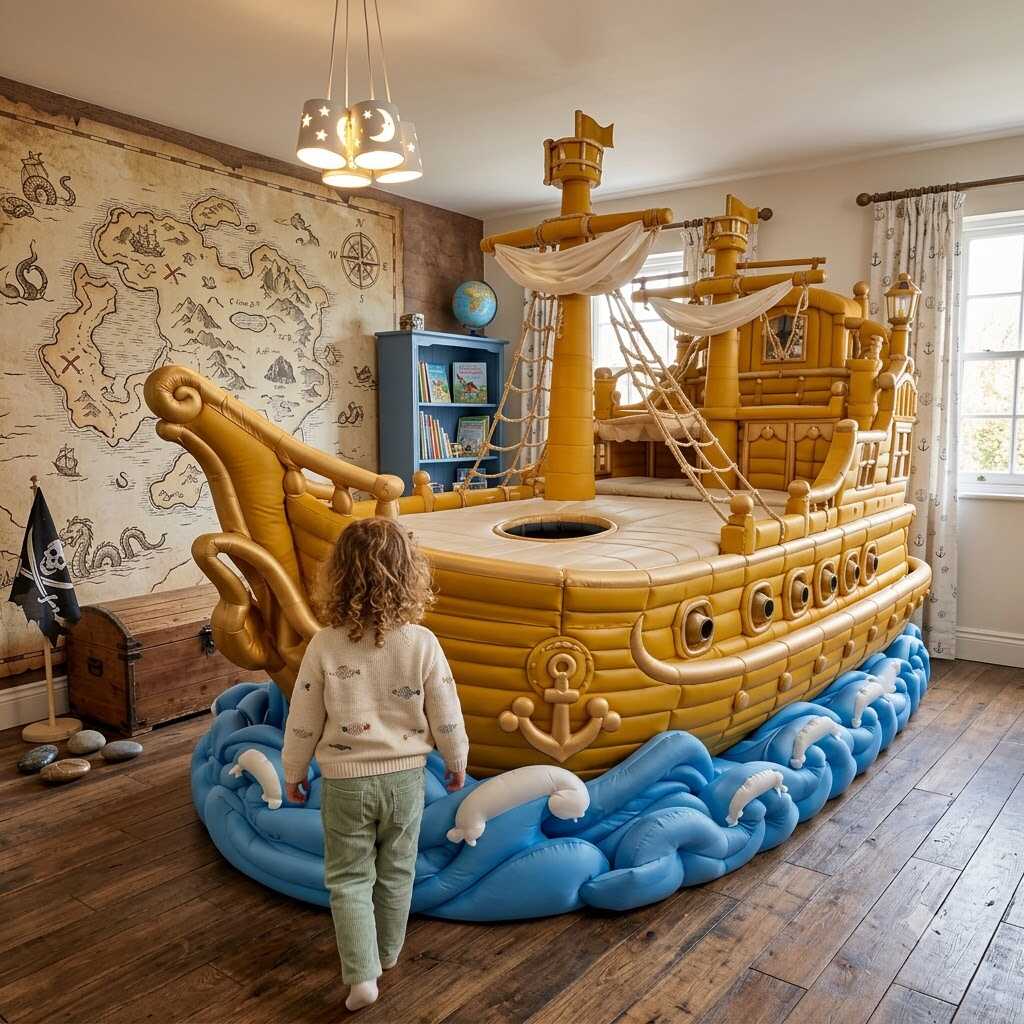
Raw foam is porous, fragile against UV light, and not remotely kid-proof, so a finishing layer is non-negotiable. Most studios apply a flexible elastomeric coating — a rubberized paint system originally developed for theme park and film-set props — which seals the foam, adds a thin protective skin, and allows for realistic texture work. This coating is typically brushed or sprayed on in multiple thin layers, sanded lightly between coats, and it’s what gives the finished PIRATE SHIP BED its slightly weathered, wood-like sheen rather than a plasticky foam look.
Color work happens after sealing. Designers often use a base coat followed by dry-brushing and glazing techniques borrowed straight from theatrical scenic painting — the same tricks used to age a stage prop. Darker glaze gets worked into the plank grooves to fake shadow and depth, while lighter dry-brush strokes hit the raised edges to simulate worn, sun-bleached wood.
Safety Testing Before Anything Ships
Because this furniture is built for children, reputable designers run their own load and impact testing before a piece is considered finished — checking edge softness, verifying there are no gaps that could trap small fingers, and confirming the coating meets flame-retardant and non-toxic standards for children’s products. Corners are rounded generously, and any protruding “mast” or decorative elements are kept well clear of areas where a child might fall against them.
The Final Product
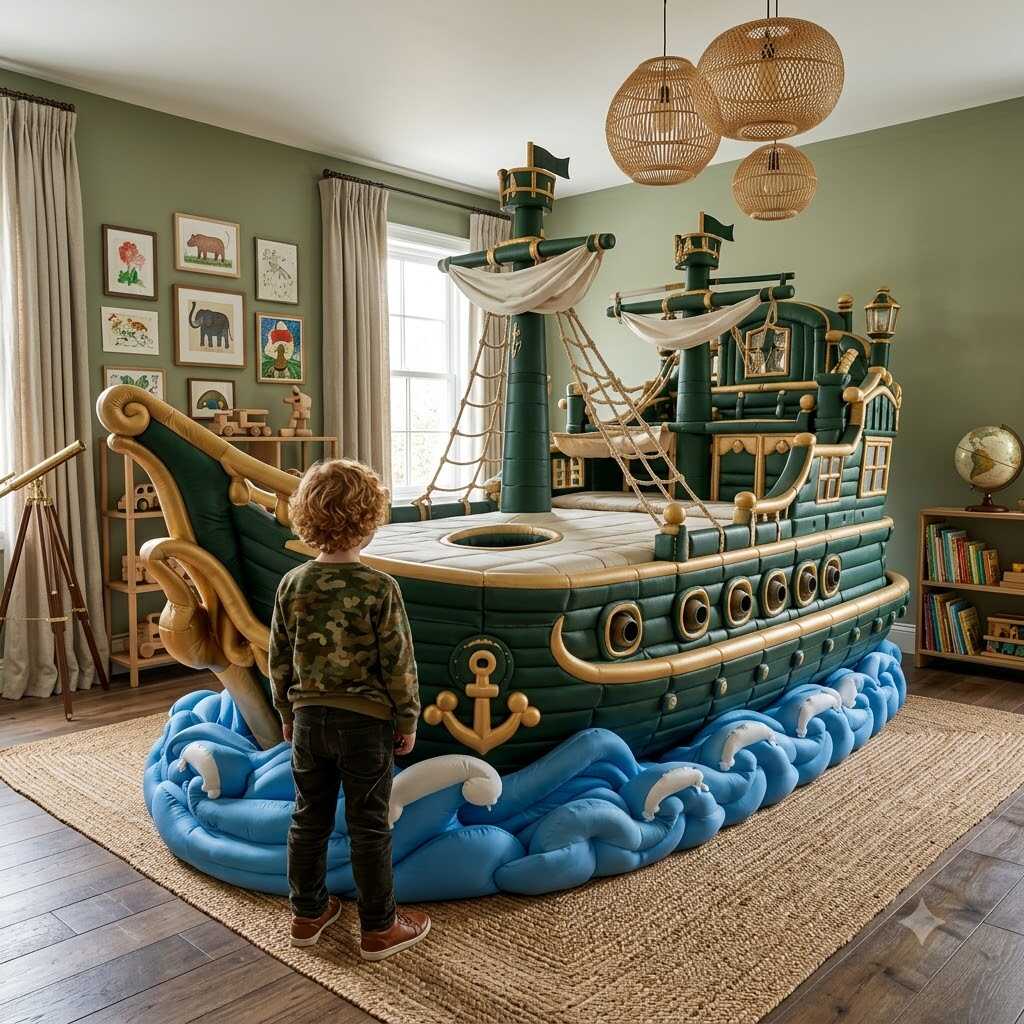
What starts as a rough mood board eventually becomes a fully sculpted, structurally reinforced, hand-finished piece that looks nothing like the raw block of foam it began as. That transformation — sketch, 3D model, foam carving, internal framing, sealing, and paint aging — is really the whole story behind every GIANT FOAM PIRATE SHIP BED that ends up looking like it sailed out of a fairy tale. It’s a genuine cross-disciplinary craft, borrowing from prop-making, structural carpentry, and theatrical painting all at once, and that’s exactly why a well-built one feels less like furniture and more like a small piece of stage design that happens to hold a mattress.
Closing Thoughts
The next time you see one of these ships in a bedroom photo, it’s worth remembering how much invisible engineering sits under that playful exterior. Behind every curved bow and weathered plank is a design process built on careful material choices, structural planning, and finishing techniques pulled from film and theater work — proof that even the most whimsical furniture pieces are, underneath it all, genuinely serious design projects.