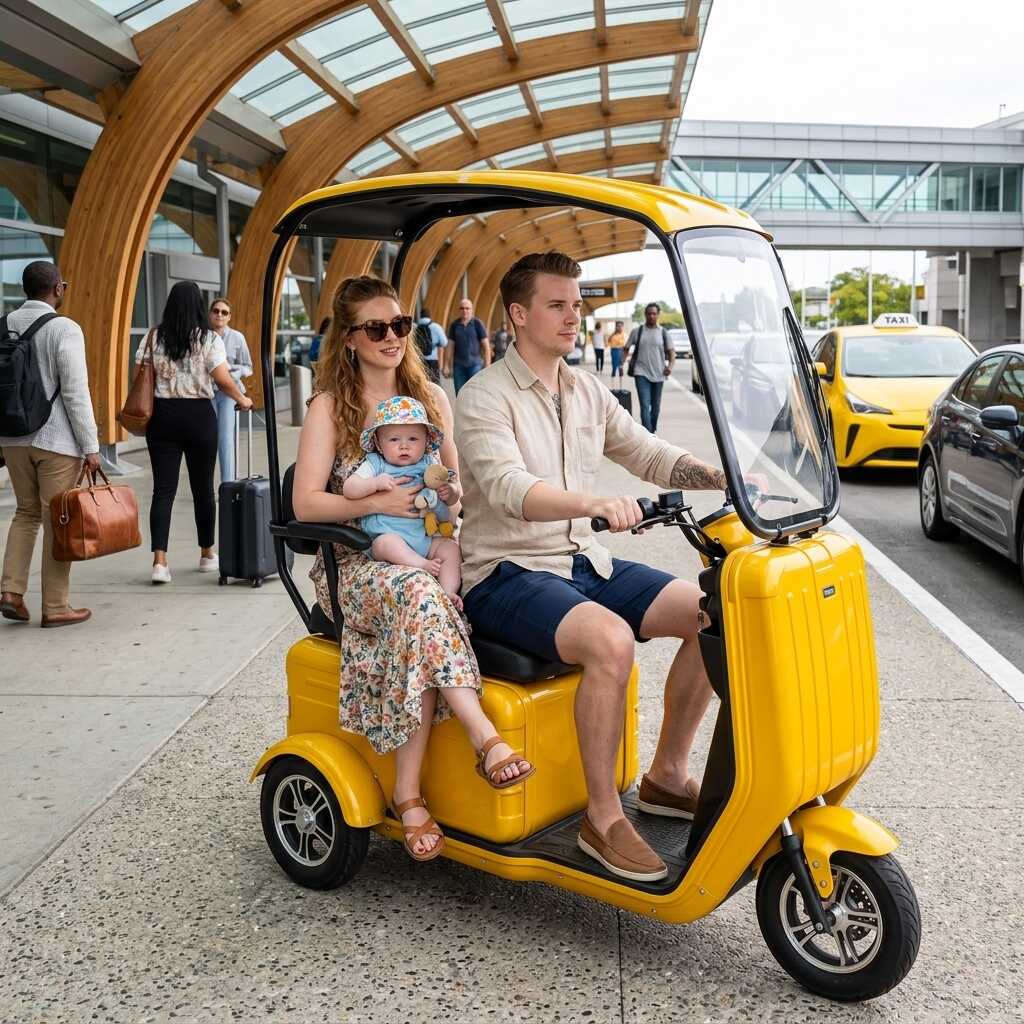
There’s a particular kind of product that catches your eye not because it does something entirely new, but because it looks like nothing you’ve quite seen before. The Luggage Inspired Scooter is one of those objects. At first glance, it reads as exactly what the name suggests — a rolling suitcase. Boxy body, hard shell, a retractable handle poking out of the top. But look again, and you’ll notice the handle isn’t just for dragging. It’s for riding.
This strange hybrid of travel gear and personal transportation has been popping up more and more in airports, college campuses, and city sidewalks, and it raises a genuinely interesting design question: what happens when you take the silhouette of a suitcase and ask it to also behave like a scooter? The answer, as it turns out, involves a surprising amount of thought about proportion, weight distribution, and the psychology of familiar shapes. This article takes a closer look at the form of the luggage-shaped scooter, why its designers chose the shapes they did, and what that shape tells us about where personal mobility devices might be headed next.
Where the Design Idea Comes From
Every unusual object has a lineage, and the luggage-shaped scooter borrows from two very different design worlds that don’t often intersect.
On one side, you have decades of luggage engineering. Suitcases have been refined for a single purpose: protect what’s inside while surviving being thrown, dropped, and dragged across every surface imaginable. That means rigid corners, a low center of gravity, and a shell that can absorb impact without deforming. On the other side, you have scooter design, which prioritizes almost the opposite set of concerns — lightness, balance, and a structure that can support a moving human body without buckling.
Merging these two design philosophies isn’t a simple mash-up. A traditional suitcase shell is built to be static, sitting still or being pulled along the ground. A scooter deck has to flex slightly, distribute a rider’s weight dynamically, and maintain stability at speed. The luggage-shaped scooter essentially asks a suitcase to do a scooter’s job without losing its suitcase identity, and that tension shows up in almost every part of its form.
The Rectangular Body: Familiar Yet Functional
The most obvious design choice is the rectangular, boxy body. Unlike most scooters, which use a slim deck and vertical stem, this design keeps the classic hard-shell luggage silhouette intact. There’s a reason for that beyond nostalgia or novelty.
A rectangular shell offers a wider footprint than a traditional scooter deck, which naturally improves stability when the device is used both for rolling and for standing on. It also preserves internal storage space — the “luggage” part of the concept isn’t purely cosmetic in many versions of this design; the shell often still opens up to hold belongings, meaning the form has to satisfy both structural and storage demands simultaneously.
The corners tend to be more rounded than a standard suitcase, which is a subtle but important shift. Sharp corners work fine when an object is being pulled behind you, but they become a liability when a device is expected to be leaned into, stepped on, or maneuvered through tight spaces. Rounding softens that risk while still keeping the boxy, recognizable outline that makes the object instantly read as “luggage” rather than “vehicle.”
The Handle-Stem Hybrid
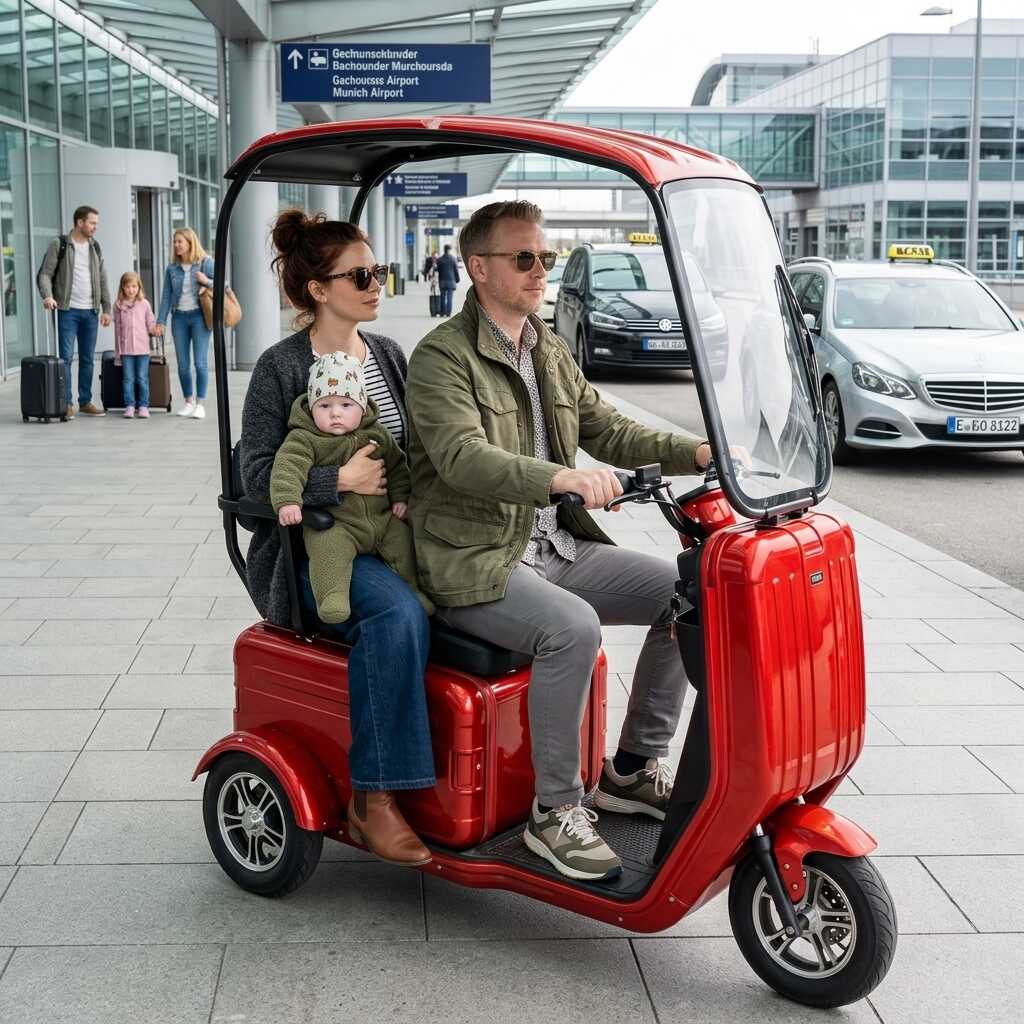
Perhaps the cleverest piece of the whole design is the handle. On ordinary luggage, the telescoping handle exists purely to give your arm leverage while walking. On this scooter, the same telescoping mechanism has to double as a steering stem, which means it needs to handle lateral force, not just a straight pulling motion.
Designers solve this in a few different ways depending on the version of the product. Some reinforce the handle’s locking mechanism so it resists side-to-side wobble. Others widen the base where the handle meets the shell, spreading out the stress instead of concentrating it at a single narrow point. The height is usually adjustable, echoing the way luggage handles extend to different lengths for different users, except now that adjustability also has to accommodate riders of different heights safely, not just the comfort of a person walking behind it.
This dual-purpose handle is really the hinge — quite literally — where the two design languages meet. It has to feel familiar in the hand, the way a suitcase handle always has, while performing an entirely different mechanical job underneath.
Wheels: Small Details With Big Consequences
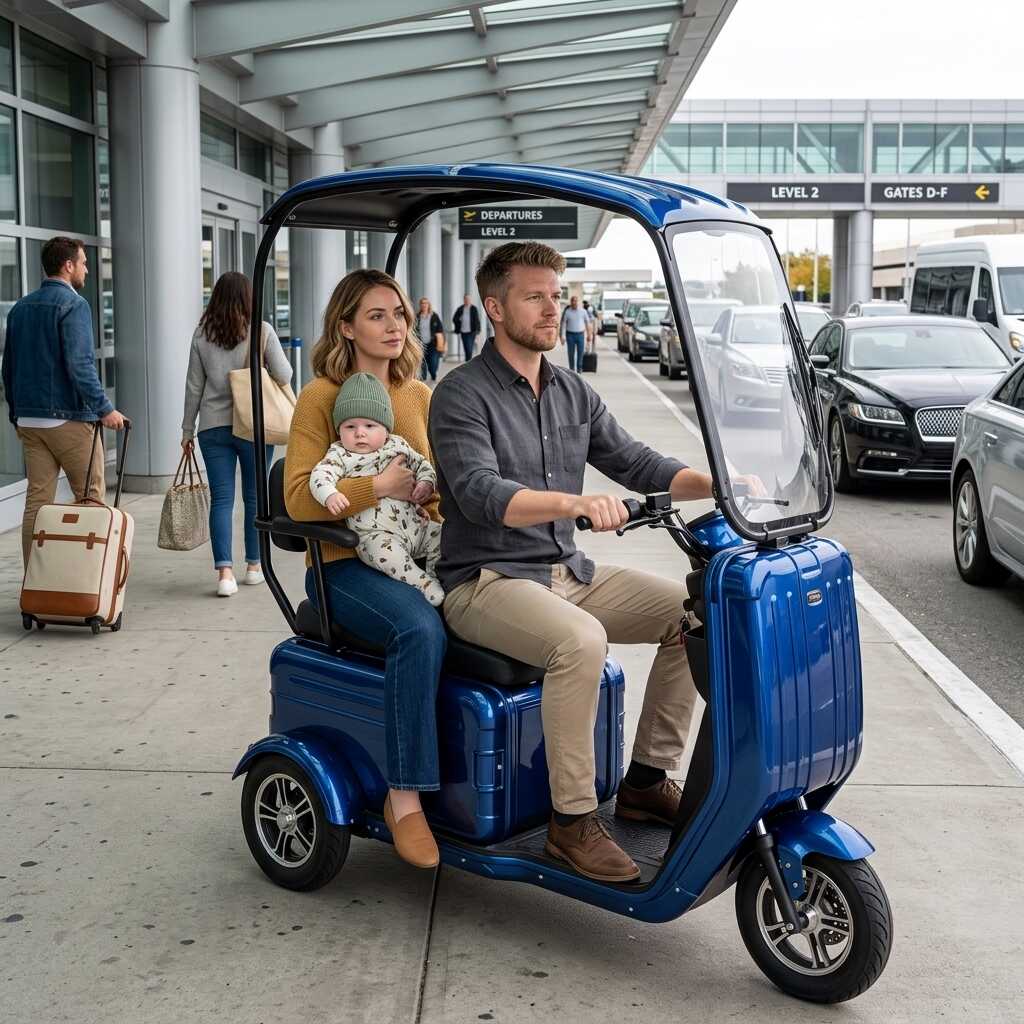
Wheels might seem like a minor detail, but they reveal a lot about how seriously a design team thought through the luggage-scooter concept. Standard suitcase wheels are small, multidirectional, and designed for smooth airport floors at walking speed. Scooter wheels, by contrast, need to handle uneven pavement, higher speeds, and the sudden shifts in weight that come from a rider shifting their stance.
Most luggage-shaped scooters end up with a hybrid wheel arrangement — slightly larger than typical suitcase casters, but smaller and harder than typical scooter wheels, positioned to keep the low profile that makes the object still resemble luggage from a distance. The placement of the wheels also affects how the shell sits and looks; positioning them too far back or too far forward changes the whole visual balance of the piece, making it look either like a suitcase that got wheels bolted onto the wrong spot or a scooter wearing an ill-fitting costume.
The Visual Language of Familiarity
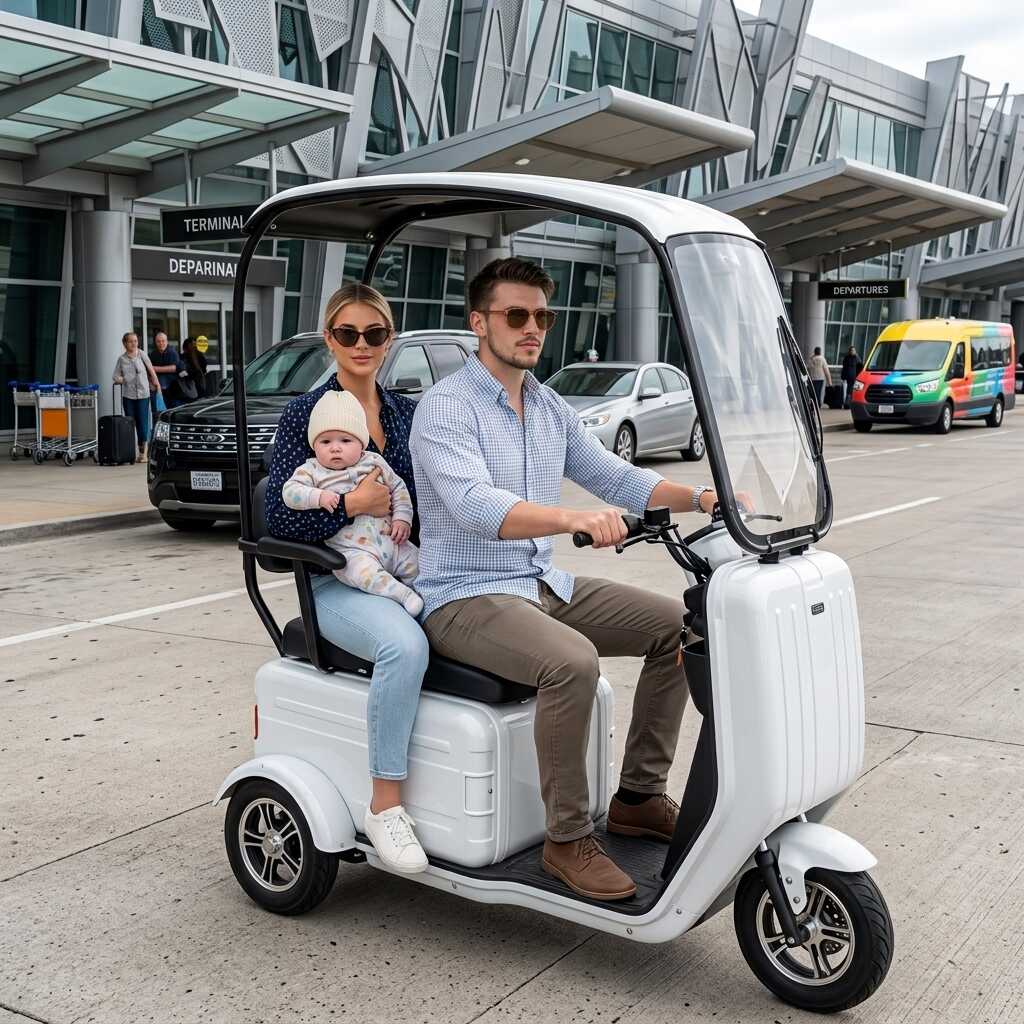
There’s a psychological layer to this shape that goes beyond engineering. Humans respond to recognizable forms with a kind of instant trust. A suitcase shape signals “travel companion” — something practical, something that belongs with you on a journey. By keeping that shape largely intact, the luggage-inspired scooter borrows that instinctive association rather than asking people to accept an entirely foreign object.
This is part of why the design leans so heavily on preserving suitcase-like proportions instead of streamlining everything into something more aerodynamic or scooter-typical. A rider or passerby doesn’t need an explanation for what they’re looking at. The shape does the explaining. That’s a subtle but powerful piece of design communication — form functioning as a kind of visual shorthand before a single word is spoken about what the object actually does.
Balancing Two Identities in One Form
What makes this design genuinely interesting to study isn’t just that it combines two functions — plenty of products do that — but that it refuses to fully commit to either. A true hybrid would probably end up looking like neither a suitcase nor a scooter, some entirely new silhouette. Instead, this design keeps one foot in each world, and the tension between those two identities is visible in every curve, hinge, and panel line.
That balancing act is delicate. Lean too far toward scooter functionality, and the object stops resembling luggage, losing the visual trust it relies on. Lean too far toward luggage authenticity, and the structural compromises needed for safe riding start to show through as awkward reinforcements or bulky add-ons. The versions of this design that work best are the ones where that tension is nearly invisible — where the shell looks like it was always meant to do both jobs, rather than looking like two separate objects stitched together.
Conclusion
The Luggage Inspired Scooter is a small but genuinely fascinating case study in industrial design. It takes two objects with very different structural demands and asks them to share a single silhouette without one canceling out the other. The rounded-but-boxy shell, the dual-purpose telescoping handle, the compromise wheel design, and the deliberate choice to preserve a recognizable suitcase profile all point to the same underlying design philosophy: familiarity and function can coexist, but only if every detail is negotiated carefully.
Whether or not this particular hybrid becomes a lasting category of personal transportation, it offers a useful lesson in how shape communicates purpose. Sometimes the most interesting designs aren’t the ones that invent an entirely new form, but the ones that quietly ask an old, trusted shape to learn a new trick.