Few automotive profiles are as universally recognized or as deeply tied to the spirit of adventure as the classic Volkswagen Type 2 Transporter. Affectionately known as the VW Bus, Camper, or Bulli, this iconic vehicle came to symbolize freedom, mid-century functionalism, and a carefree counterculture movement. Decades after its debut, its distinct aesthetic blueprint continues to inspire designers across various industries.
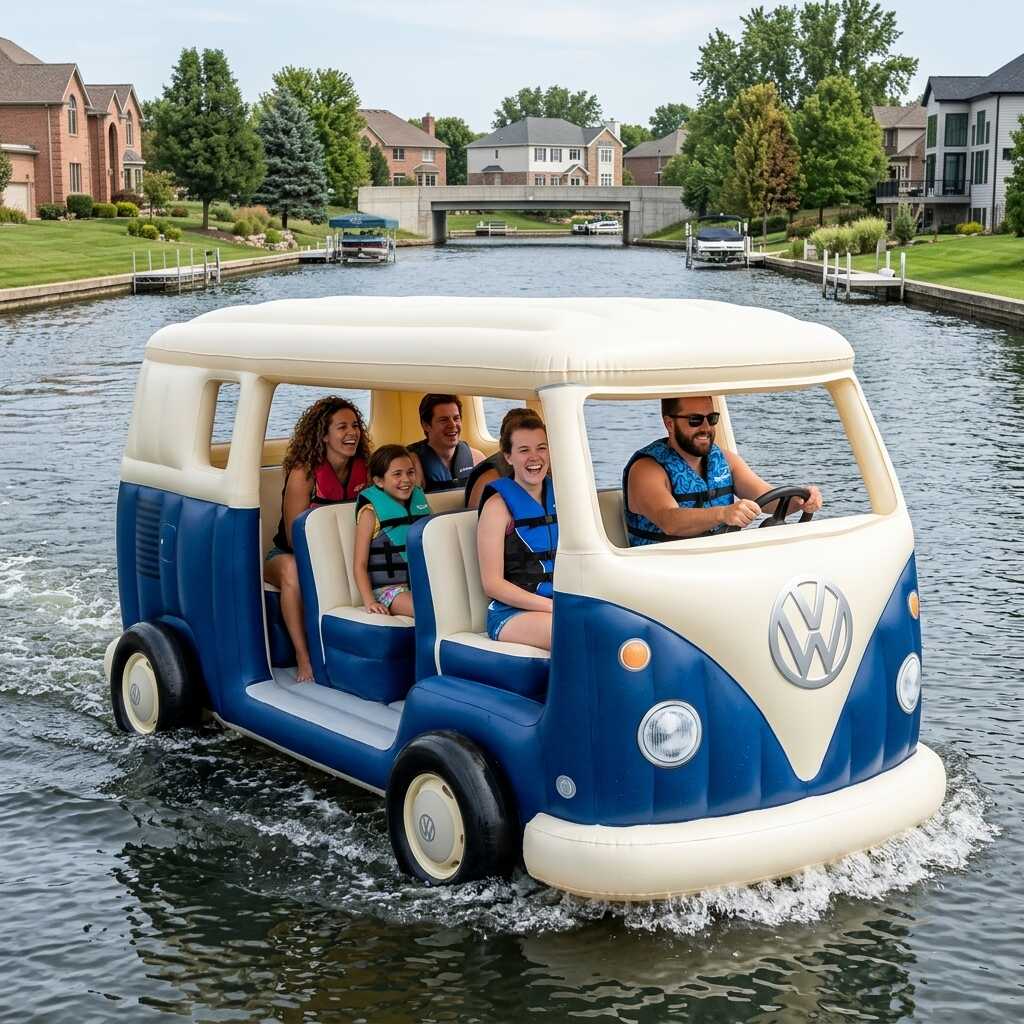
One of the most ambitious and visually striking adaptations of this legacy is its translation from land to water: the Inflatable Volkswagen Bus Shaped Boat. Capturing the essence of a beloved terrestrial icon and re-engineering it to float seamlessly on water requires a delicate balance of nostalgic preservation and marine engineering. This article explores the design journey behind this unique watercraft, looking into the aesthetic inspirations, the physical engineering challenges, and the precise material and color choices that brought this floating tribute to life.
Part I: The Architectural Blueprint – Translating Land to Water
The primary challenge in conceptualizing the Inflatable Volkswagen Bus Shaped Boat lies in the fundamental conflict between automotive design and naval architecture. A classic vehicle is inherently geometric, defined by crisp corners, vertical panels, and flat glass surfaces. Conversely, inflatable watercraft rely on internal air pressure, which naturally forces material into rounded, cylindrical shapes.
Bridging the Geometric Divide
To maintain the undeniable silhouette of the VW Bus, designers could not simply print a vehicle graphic onto a generic oval raft. Instead, they utilized multi-chamber internal drop-stitch construction and strategically placed bulkheads. Drop-stitch technology employs tens of thousands of fine polyester threads connecting two parallel fabric layers, allowing the inflatable panels to be pumped to a high pressure while maintaining a perfectly flat, rigid surface. This engineering choice allows the boat to feature the flat side panels, distinct squared-off rear engine bay aesthetic, and a stable, flat floor deck reminiscent of the original vehicle’s interior.
Preserving the Split-Screen Silhouette
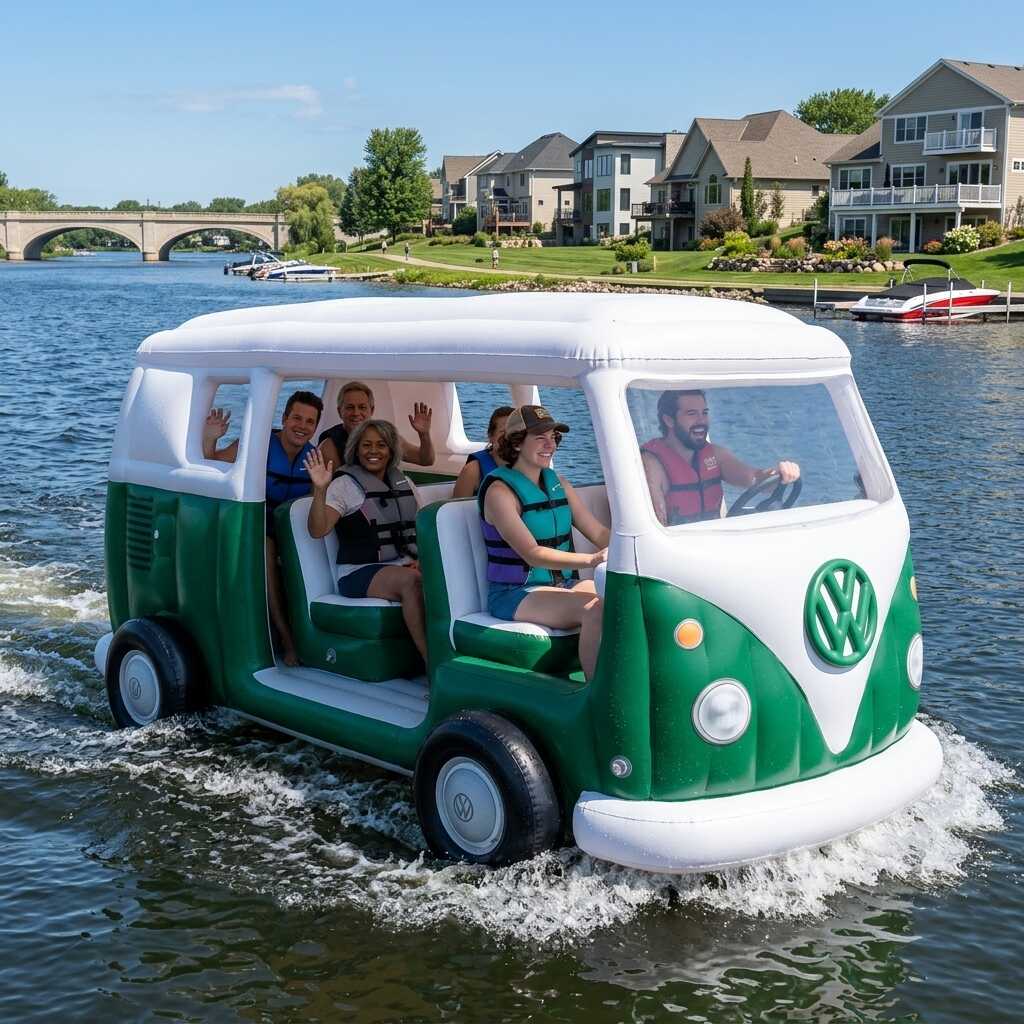
The defining feature of the earliest VW buses—the “Splittie” or split-windshield design—serves as the focal point of the boat’s forward construction. Achieving this look required custom-molded PVC framing. The forward-facing section of the watercraft rises at a precise slope, mimicking the exact angle of the original cabin nose. By using distinct inflatable chambers to separate the dual windshield segments, the design honors the historic layout while doubling as a functional wind-deflector for passengers on board.
Part II: Anatomy of Appearance – Exterior Details and Functional Anatomy
A successful tribute design relies entirely on the accuracy of its details. When creating the Inflatable Volkswagen Bus Shaped Boat, every distinctive component of the classic automotive body had to be reimagined as a functional, water-resilient element.
The Iconic Front “V” and Emblem
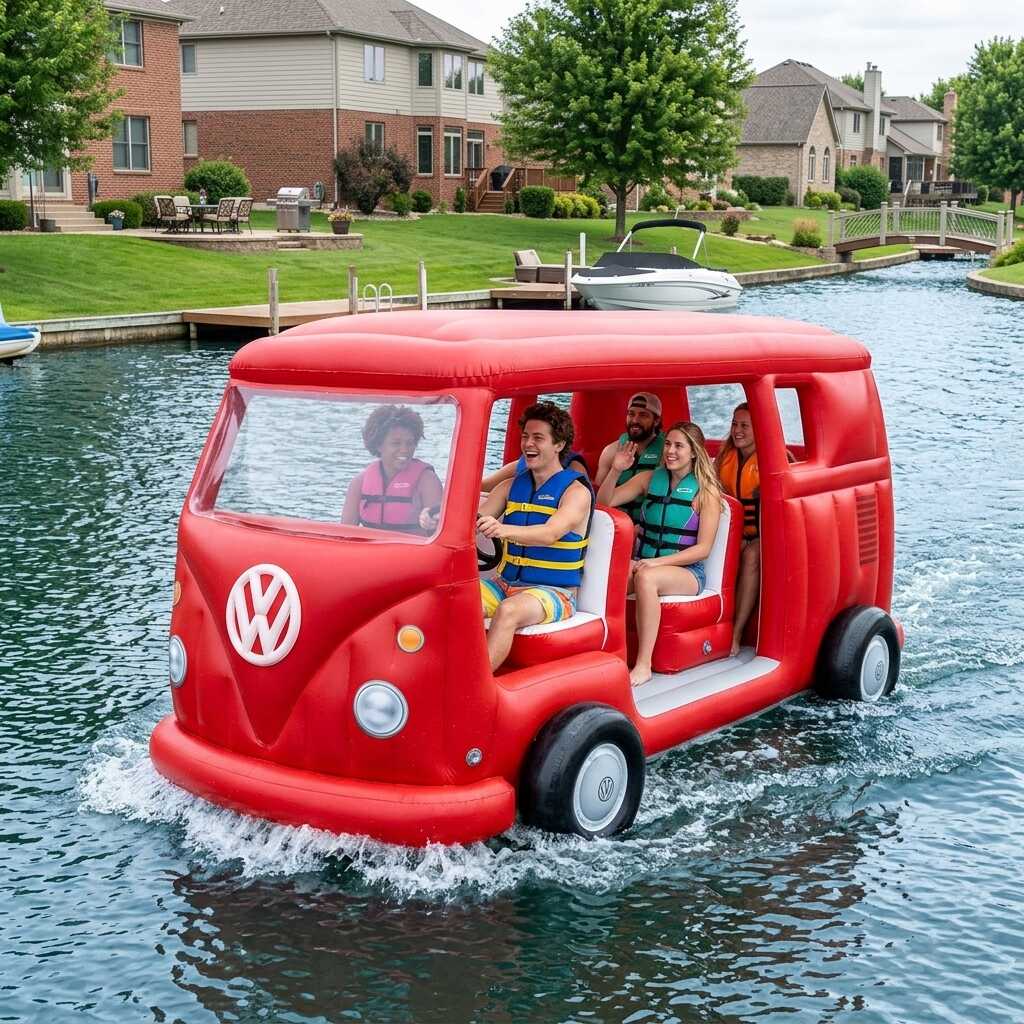
On the original vehicle, the front fascia is dominated by a sweeping, raised “V” shape that converges toward the bumper, anchoring a massive chrome logo. On the watercraft, this “V” is achieved through layered material welding. Rather than a flat print, the decorative panel is a raised, secondary layer of fabric that adds physical texture and depth to the bow. At the center sits an oversized, molded rubber medallion. Because a rigid metal or hard plastic emblem would present a safety hazard on an inflatable craft, designers engineered a high-density, flexible composite logo that withstands the elements while mimicking the dimensional look of vintage chrome.
Windows, Trim, and Air Intake Mimicry
The charming aesthetic of the VW Bus is largely due to its abundance of windows—most famously celebrated in the 23-window deluxe models. For the floating counterpart, these window arrays are represented by dark, high-gloss marine vinyl panels thermally welded to the upper canopy. The precise spacing of these panels creates the optical illusion of a pillared cabin structure.
Along the rear quarters, where the air intakes for the rear-mounted, air-cooled engine would traditionally sit, designers integrated slatted rubber overlapping vents. These vents are not merely aesthetic; they serve a secondary structural purpose as reinforcement patches over the inflation valves, neatly concealing the modern mechanical touchpoints beneath vintage design cues.
Wheel Wells and the Faux Undercarriage
An automobile requires wheels, but a boat requires a clean hull. To bridge this visual gap, the bottom perimeter of the Inflatable Volkswagen Bus Shaped Boat features recessed crescent cutouts that mirror the classic wheel wells. Within these recesses, dark heavy-duty rubber rubbing strakes are curved to simulate the upper curvature of tires. This allows the craft to retain its automotive identity when viewed from the side profile at water level, without compromising the hydrodynamic flow of the flat-bottomed or catamaran-style hull hidden beneath.
Part III: Materials Science – The Engineering Behind the Inflatable Form
An exceptional design is only as good as the medium through which it is realized. Because this product is an inflatable vehicle meant to withstand the dynamic forces of open water, UV exposure, and shifting internal pressures, the choice of materials was strictly governed by durability and structural fidelity.
Commercial-Grade Reinforced PVC and TPU
The core skin of the Inflatable Volkswagen Bus Shaped Boat is constructed from heavy-duty, 1100 Denier military-grade polyvinyl chloride (PVC) interleaved with a polyester structural tear-stop mesh core. This fabric provides the high tensile strength necessary to hold the rigid, boxy shape of a bus without bulging or distorting under pressure. For areas requiring high flexibility and premium tactile feel—such as the seating areas and interior dashboard console—Thermoplastic Polyurethane (TPU) coatings are utilized. TPU offers superior resistance to abrasions and fading, ensuring the structural seams remain intact even after repeated inflation and deflation cycles.
High-Frequency Welding Over Adhesives
Traditional inflatables often rely on glued seams, which can break down under prolonged exposure to heat, water, and sunlight. To ensure the sharp, clean lines of the VW Bus design remain crisp over time, the entire craft is assembled using high-frequency (HF) electromagnetic welding. This process melts the molecules of adjacent panels together at the atomic level, creating a single, fused bond that is actually stronger than the surrounding material. This technique allows for incredibly narrow seam lines, which are critical for mimicking the tight sheet-metal gaps of classic automotive bodywork.
Part IV: The Palette of the Past – Color Theory and Historic Accuracy
Color is perhaps the most immediate emotional trigger in design. The mid-century era that birthed the original Transporter was defined by soft pastel tones, matte finishes, and distinct two-tone paint schemes. Replicating this exact visual mood on modern synthetic textiles required careful calibration.
The Signature Two-Tone Split
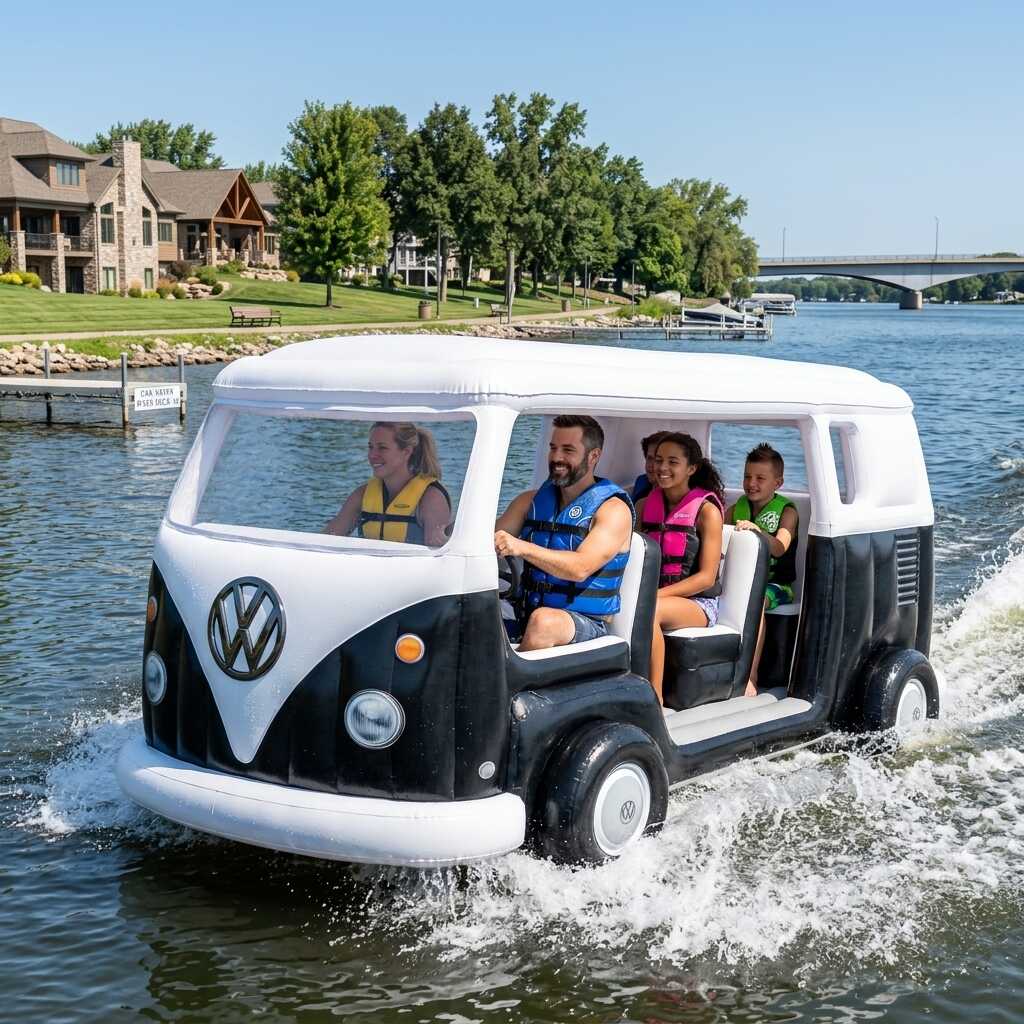
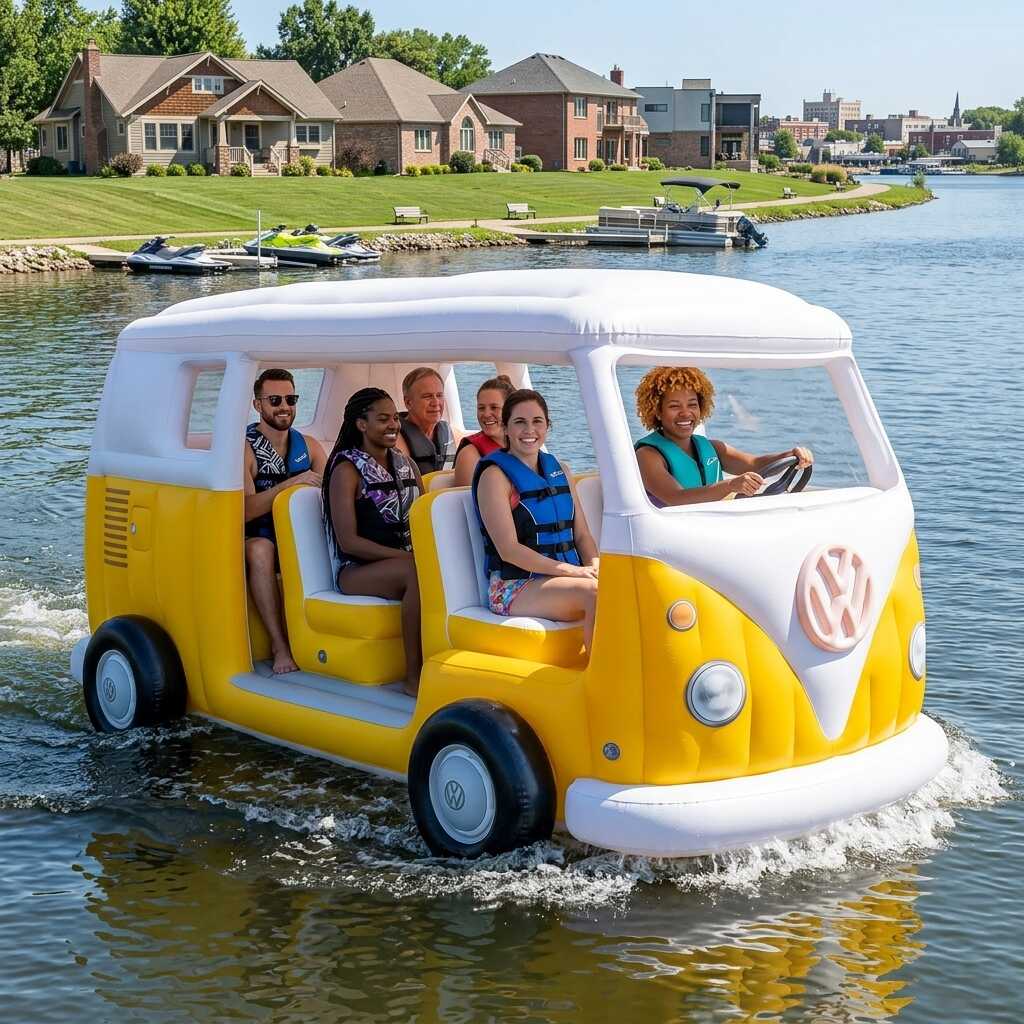
A hallmark of vintage VW design is the two-tone color configuration, where the upper cabin structure is painted a clean, stark white, while the lower body wears a vibrant, saturated hue. The Inflatable Volkswagen Bus Shaped Boat faithfully adopts this split. The upper columns, roof section, and front “V” accent are rendered in a soft, milk-white matte finish. This specific shade was selected over a harsh, modern optic white to maintain an authentic retro warmth and to minimize harsh sun glare off the water’s surface.
Historic Palette Selection
For the lower half of the hull, designers pulled inspiration directly from historical Volkswagen color charts of the 1960s. Rather than using primary, generic colors, the fabric dyes are mixed to replicate specific vintage tones:
-
Seaspray Turquoise: A muted, green-leaning blue that evokes coastal heritage and blends harmoniously with marine environments.
-
Clementine Orange: A warm, earth-toned orange that captures the vibrant energy of late-60s adventuring.
-
Mouse Grey: A sophisticated, minimalist neutral that highlights the clean architectural lines of the craft’s exterior layout.
Matte vs. Gloss Contrast
To add further visual depth, the color palette utilizes contrasting material finishes. The main body fabric features a satin-matte texture that absorbs light similarly to vintage automotive acrylic paint. This is contrasted against the deep, high-gloss black and smoke-grey translucent panels used for the faux windows and windshields. This interplay of light absorption and reflection prevents the large inflatable object from appearing flat or visually heavy on the water, ensuring it looks like a sculpted, dimensional vehicle from afar.
Conclusion: A Masterclass in Aesthetic Adaptation
The creation of the Inflatable Volkswagen Bus Shaped Boat demonstrates the enduring power of thoughtful design. By treating the original vehicle not merely as a logo to print, but as a complex architectural form to re-engineer, designers successfully bridged the gap between land-based nostalgia and water-based utility.
Through the strategic use of rigid drop-stitch panels, high-frequency welded PVC, and a strictly curated historic color palette, the craft honors its automotive roots down to the finest detail. It stands as a compelling example of how historical design language can be extracted, adapted, and beautifully preserved in an entirely different physical medium, transforming a beloved piece of mid-century Americana into a striking modern watercraft.